

Rotator Cuff Tear vs. Tendinopathy:
How They Feel Different
Written by Dr. Tim Berreth, DPT
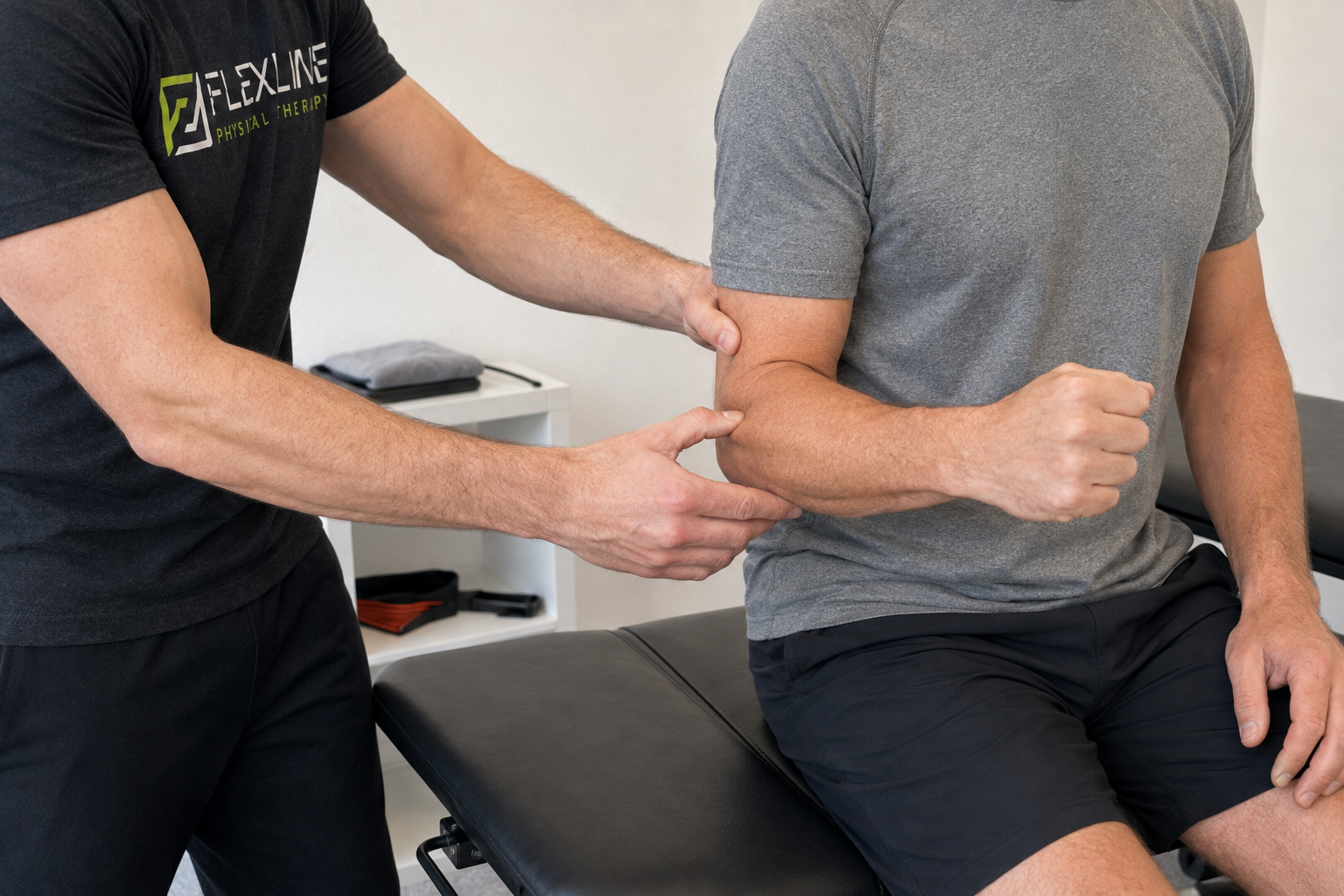
Rotator cuff tendinopathy is irritation and breakdown inside the tendon from repeated load, without a full separation of the fibers. A rotator cuff tear is a partial or complete disruption of those fibers.
Both can cause pain reaching overhead, lifting, or sleeping on the affected side, and both can cause weakness, so the symptoms alone often do not settle which one is present.
That distinction usually comes from a hands-on strength and movement assessment, sometimes followed by imaging, rather than from how the pain feels day to day.
What's actually different between the two
Tendinopathy is a spectrum. Tendon tissue that is loaded beyond its current capacity, whether from a training spike, poor recovery, or long term overuse, starts to break down at the cellular level before any structural gap forms.
A tear is a step further: some or all of the tendon fibers have physically separated from each other or from the bone. A partial tear behaves more like an advanced tendinopathy. A full thickness tear usually produces a more specific pattern of weakness that a movement assessment can pick up.
Signs that lean toward tendinopathy
What we look for:
pain that builds gradually over weeks, worse after activity rather than during one specific movement, strength that is present but painful to produce, and a training change (more volume, more overhead work, a new lifting program) in the weeks before symptoms started.
How that shows up day to day:
you can usually still lift the arm and generate force, it just hurts to do it, and the pain tends to ease somewhat with a short warm-up before returning during or after the session.
Signs that lean toward a tear
What we look for:
a specific weakness that does not improve with a warm-up, a noticeable strength drop on manual muscle testing compared to the other side, sometimes a single traumatic event (a fall, a sudden pull) rather than a gradual build, and in some cases an inability to actively raise the arm through part of the range even though passive range is close to normal.
How that shows up day to day:
certain motions may feel like the shoulder is giving way rather than just hurting, and strength deficits tend to stay consistent instead of varying with how warmed up you are.
Age and activity history matter too. Rotator cuff tears become more common with age even in people without pain, so a tear found on imaging is not automatically the source of current symptoms. Teunis et al., 2014 age-stratified systematic review
What you can safely try
Keep the arm moving within a pain free or low pain range rather than resting it completely
Avoid testing strength aggressively on your own if a tear is suspected, a heavy attempt can turn a partial tear into a larger one
Modify load and range on movements that reproduce sharp pain, rather than avoiding all upper body training
Track whether symptoms are trending toward gradual improvement or staying flat over one to two weeks
Signs this should be assessed
Get a shoulder evaluated if there is a clear strength deficit compared to the other side, if pain followed a specific traumatic event, if you cannot actively lift the arm through part of its range, or if two to three weeks of modified activity has not produced any improvement. A strength and movement assessment can usually tell tendinopathy and a partial tear apart well enough to guide a plan, even before any imaging is ordered.
When imaging or a referral may be appropriate
Imaging is not always the first step. Ultrasound or MRI becomes more useful when there is a suspected full thickness tear, a significant traumatic mechanism, a strength deficit that is not improving with a structured plan, or when surgical evaluation is being considered.
Desmeules F, et al., J Orthop Sports Phys Ther. 2025;55(4):235–274
Frequently Asked Questions
-
Yes, tendon tissue that stays overloaded without enough recovery capacity can progress from irritation to a partial tear over time. That is part of why addressing tendinopathy early matters.
-
Not automatically. Many partial tears and even some full thickness tears respond well to a structured strengthening program. The decision depends on tear size, your goals, and how you respond to a trial of rehab.
-
No. X-rays show bone, not tendon. Ultrasound or MRI are the imaging options that can visualize the rotator cuff itself.
-
Usually yes, with load and range modified to stay under the pain threshold that triggers a flare. Complete rest is rarely necessary and can slow recovery by de-conditioning the tendon further.
Still unsure what is driving your shoulder pain?
Related reading
Shoulder Pain Treatment for Active Adults in League City, TX
Shoulder Pain After Lifting Weights: What to Modify and What to Check
This page is for general education and isn't a substitute for individual medical advice. Seek urgent care for sudden severe pain with deformity, numbness or weakness spreading down the arm, signs of infection, or chest pain and shortness of breath alongside shoulder pain.