
Returning to Sport After ACL Reconstruction: What Objective Testing Looks Like
Written by Dr. Tim Berreth, DPT
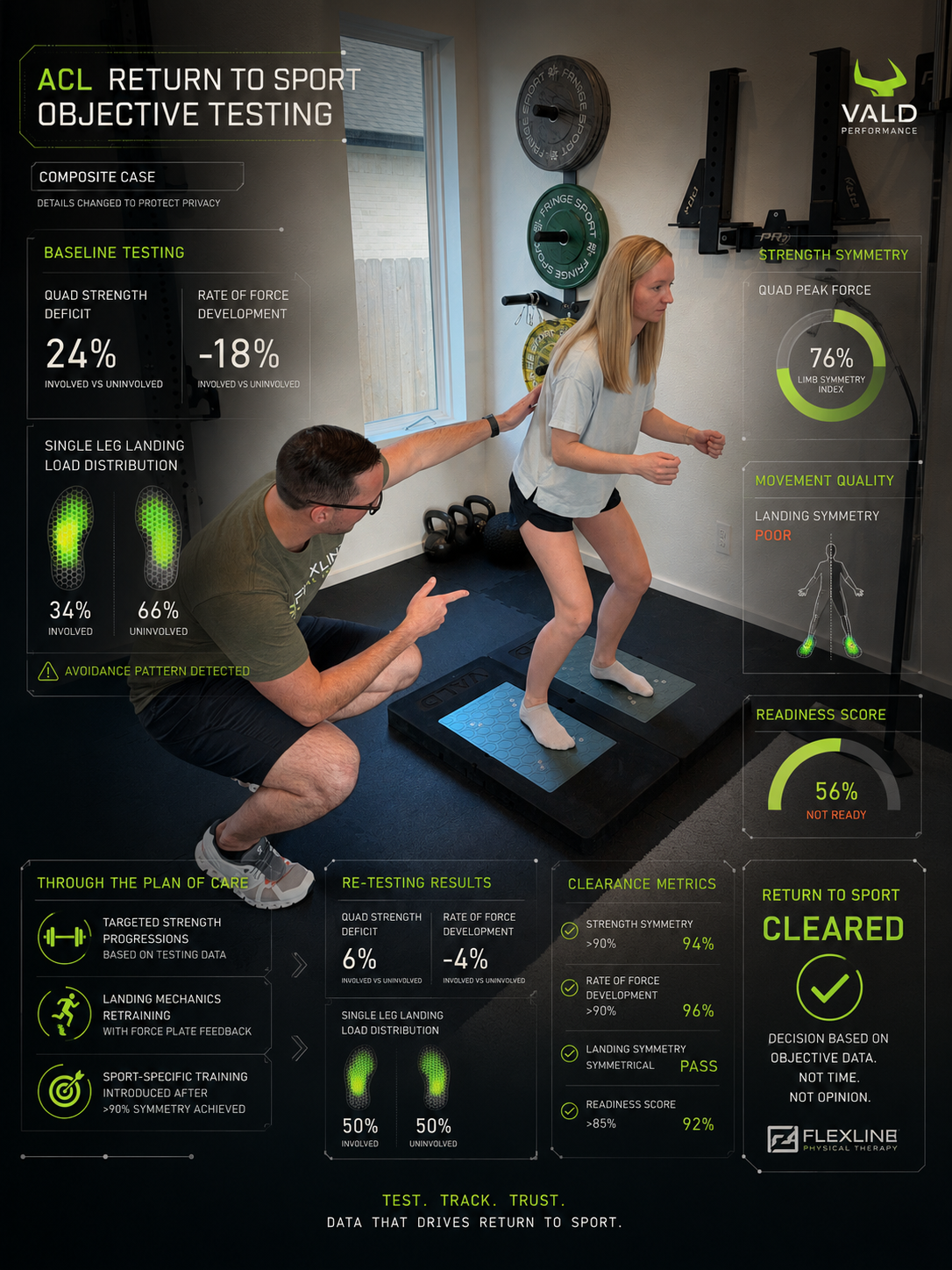
"When can I play again" is the question every ACL patient asks. Here's how we actually answer it, using a composite case built from patients we've treated through this exact process. Details have been changed and combined to protect privacy.
The starting point
A club-level athlete, months out from ACL reconstruction, cleared by their surgeon for "activity as tolerated" but with no clear return-to-sport benchmark. That's a common gap: surgical clearance and sport-ready are not the same thing, and most rehab programs don't measure the difference.
What baseline testing showed
Initial VALD force plate testing showed a meaningful strength deficit in the involved leg's quad compared to the uninjured side, along with slower rate of force development and a visible avoidance pattern on single-leg landing, meaning the athlete was unconsciously shifting more load onto the healthy leg without realizing it.
What the plan of care addressed
Progressive strength loading targeting the specific deficit shown in testing, not a generic protocol
Landing mechanics retraining using real-time feedback from force plate data
Sport-specific movement reintroduction once strength symmetry improved past 90%
What clearance looked like
Re-testing showed the strength deficit closed to within the accepted return-to-sport threshold, with symmetrical landing mechanics confirmed on force plate video. That's what cleared the return to full training, not a calendar date, not how the knee felt in the clinic that day.
Why this matters
Re-injury rates after ACL reconstruction are meaningfully higher when athletes return based on time alone rather than objective strength and movement symmetry. Testing turns "I think I'm ready" into a number everyone can trust.
Key takeaway: Time since surgery tells you how long it's been. Testing tells you if you're actually ready.
Navigating an ACL Recovery?
If you want an objective answer instead of a guess before you return to sport, testing is where that answer comes from.
