

Shoulder Pain Treatment for Active Adults in League City, TX
Written by Dr. Tim Berreth, DPT
Who this page is for
If shoulder pain is changing how you lift, swing, throw, or sleep, this page is for you. Flexline Physical Therapy works with active adults in League City who want a straight answer about what's going on in their shoulder and a plan to keep training while it gets better. That includes lifters, golfers, pickleball players, disc golfers, swimmers, and anyone whose shoulder is getting in the way of daily life.
Every visit is one-on-one with the same physical therapist for the full session. The plan is built around your goals and your sport, not a set number of visits a policy allows.
Common shoulder symptoms
Shoulder pain shows up differently for everyone, but a few patterns are common:
A dull ache that builds through a workout, round, or match.
Clicking or popping, with or without pain.
Sharp pain on specific movements, like reaching overhead or driving through a lift.
A shoulder that feels weak or unstable, especially overhead.
Pain that wakes you up or won't let you get comfortable on your side at night.
Pain that eases with rest but comes right back once you're active again.
Common causes and diagnoses
A few conditions account for most shoulder pain in active adults:
Rotator cuff tendinopathy.
Irritation of the rotator cuff tendons from repeated load, often without a single injury moment.
Rotator cuff tear.
A partial or full tear in one of the rotator cuff tendons, which can happen gradually or from a specific injury.
Shoulder impingement / rotator cuff related shoulder pain.
A catch-all term for pain with overhead movement. It describes a symptom pattern more than one exact structure, which is part of why treatment focuses on the movement fault, not just the label.
Frozen shoulder (adhesive capsulitis).
Progressive stiffness and pain that limits range of motion, often over weeks to months.
AC joint pain.
Pain at the top of the shoulder, often worse with cross-body movement or direct pressure.
Biceps tendinopathy.
Pain at the front of the shoulder, often aggravated by lifting or overhead work.
Labral and SLAP injuries.
Damage to the cartilage rim of the shoulder socket, sometimes with catching or a sense of instability.
Calcific tendinopathy.
Calcium buildup in a rotator cuff tendon, which can cause a sudden flare of sharp pain.
Terms like "impingement" describe a pattern of symptoms, not a single confirmed cause. Two people with the same diagnosis can need very different treatment.
Pain with sleeping, reaching, lifting, and throwing
Sleeping
Side sleeping compresses the shoulder and can aggravate rotator cuff and bursa tissue that's already irritated. This is one of the most common complaints we hear and usually improves once the underlying capacity issue is addressed, not just with a different pillow.
Reaching
Pain with overhead reaching often points to rotator cuff or subacromial involvement, especially if it's worse in a specific arc of motion.
Lifting
Bench press, overhead press, and pulling movements load the shoulder differently. Pinpointing which movement hurts, and where in the movement, helps narrow down what's actually happening.
Throwing
Disc golf, baseball-style throwing motions, and overhead racquet sports put the shoulder through fast, repeated rotational load. This is a volume and capacity problem more often than a single bad rep.
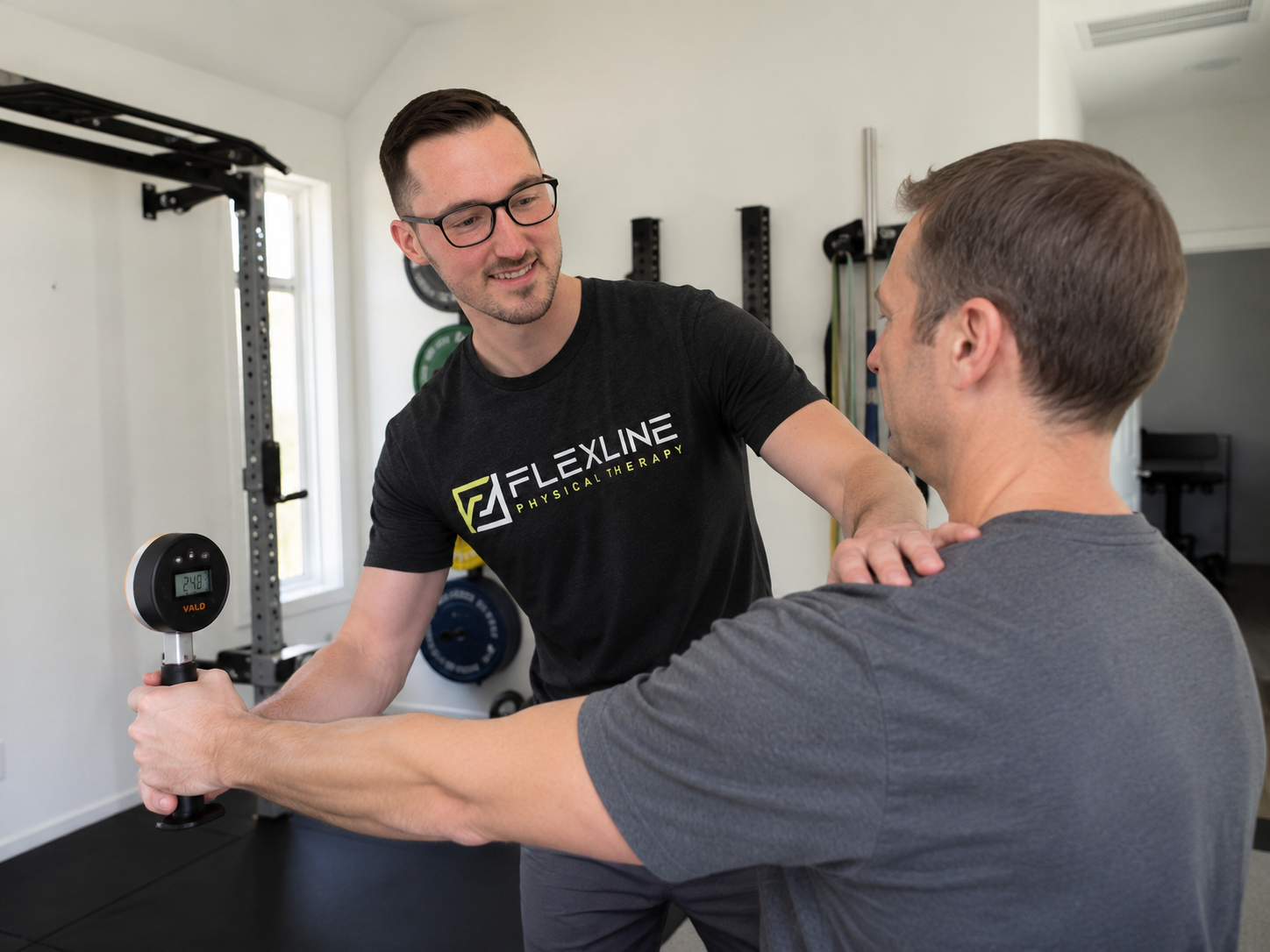
The evaluation starts with your history: when it started, what makes it better or worse, and what you're trying to get back to. From there we run a movement and strength assessment to find the actual limiting factor, whether that's a mobility restriction, a scapular control issue, or a rotator cuff strength deficit.
When it's useful, we use VALD dynamometry to get an objective strength baseline instead of guessing. That baseline also gives us a clear number to re-test against as you progress, so "feeling better" gets backed up by "testing better."
How the shoulder evaluation works
Treatment options
Treatment is built around what the evaluation finds, and may include:
Structured strength work that rebuilds the shoulder's capacity for the demands you're putting on it, rather than avoiding load altogether.
1.
Progressive loading.
Addressing restrictions that are limiting normal movement and putting extra strain on other structures.
2.
Mobility work.
Hands-on treatment to reduce pain and improve movement quality alongside the exercise plan.
3.
Manual Therapy.
Used for specific muscular trigger points and tightness that are limiting movement or contributing to pain.
4.
Dry needling.
May be used for tendinopathy and calcific tendinopathy when appropriate, as one part of the plan.
5.
StemWave shockwave therapy.
No single tool here is the whole solution. Each is used when it fits your specific findings, alongside a loading plan that addresses why the pain started in the first place.
Modify Training.
Don’t just stop.
OUR APPROACH
The default advice for shoulder pain is often "rest it." Rest reduces symptoms temporarily, but the shoulder goes right back to the same demand the moment you return, with no more capacity than before. That's why pain often comes back a few sessions after a break.
Our approach is to modify volume, load, or form during treatment so you can keep training while you build the capacity to handle it. For most active adults, that's a better path than stopping completely and hoping it's better later.
When imaging or a referral may be appropriate
An MRI or X-ray becomes more useful when there's suspicion of a significant structural issue, such as a possible full-thickness tear, when there's been a specific traumatic injury, or when a structured course of rehab hasn't produced expected progress. When that's the case, we'll refer you to an orthopedic specialist and coordinate with them directly. [cite: current CPG guidance on imaging thresholds for rotator cuff disorders, e.g. the 2025 JOSPT rotator cuff tendinopathy CPG or the 2022 rotator cuff disorders CPG]
Most shoulder pain doesn't need imaging to start treatment.
🚩 Red flag: When to seek urgent care
Most shoulder pain is safe to address with an evaluation and a plan. Seek urgent or emergency care instead if you have:
Sudden, severe pain after a significant injury, with visible deformity or inability to move the arm
Shoulder pain with fever, redness, or warmth around the joint
New numbness, tingling, or weakness spreading down the arm
Shoulder or arm pain along with chest pain, pressure, shortness of breath, or sweating, which can signal a cardiac event and needs emergency evaluation
-
Usually no. Most active adults can keep training with modifications while the underlying issue is addressed. Stopping completely often just delays the same pain.
-
Both can feel similar early on. A movement and strength assessment can usually tell the difference without needing an MRI first.
-
Not in most cases. Imaging is more useful when there's suspected significant structural damage or when progress stalls despite a good rehab effort.
Frequently Asked Questions
-
Often yes, with modifications to volume or mechanics while your capacity builds back up. This gets decided based on your evaluation, not a blanket rule.
-
It depends on the diagnosis and how long the issue has been present, but many active adults see meaningful progress within 6 to 8 weeks of a structured plan.
Still unsure what is driving your shoulder pain?
This page is for general education and isn't a substitute for individual medical advice. If you're experiencing any of the red flags above, seek emergency care.