

Shoulder Pain After CrossFit or Overhead Training
Written by Dr. Tim Berreth, DPT
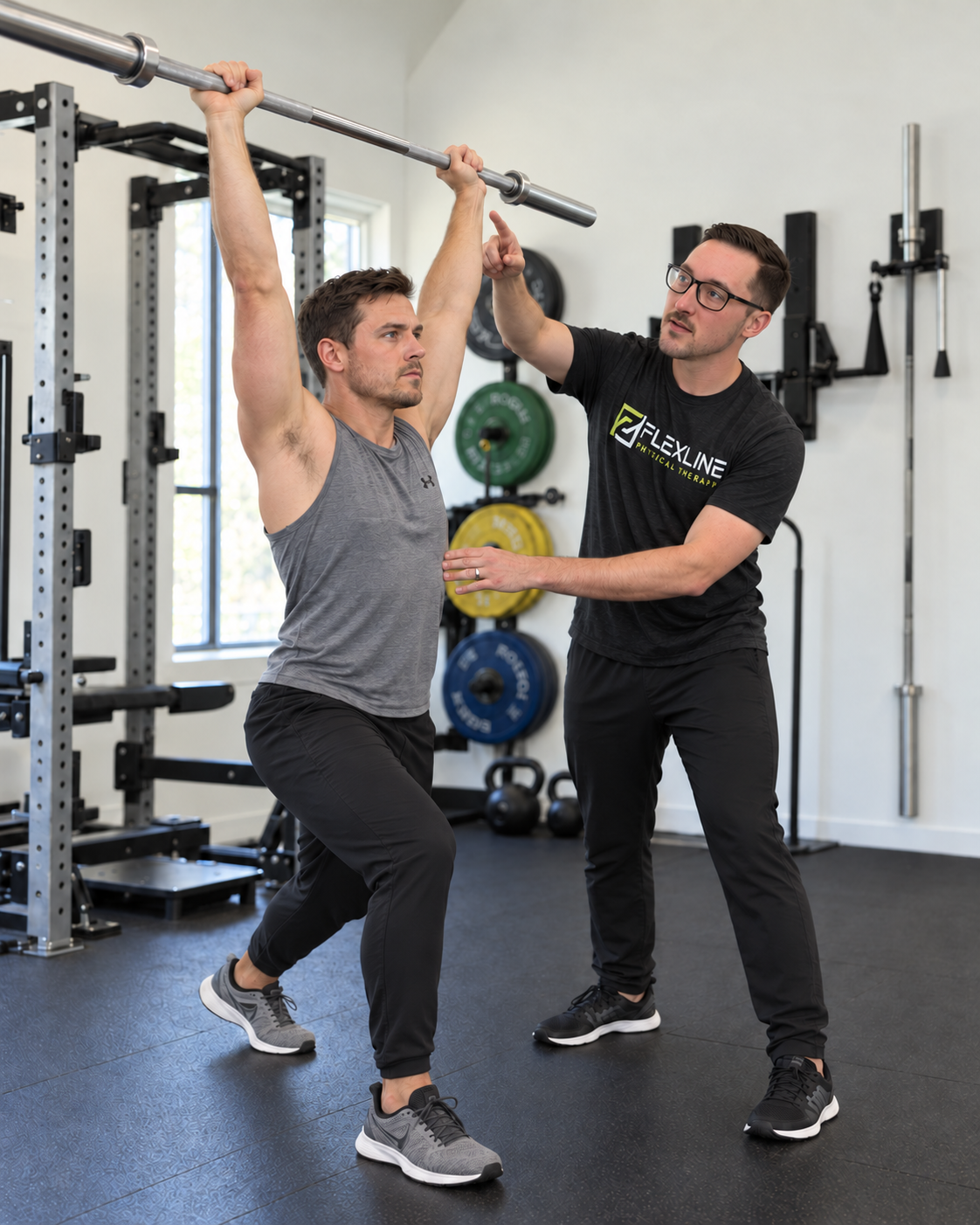
Shoulder pain after CrossFit or overhead training is usually less about one bad movement and more about how much overhead work was done, in what positions, and how fatigued the shoulder was by the end. Snatches, overhead squats, push press, kipping pull-ups, and handstand work all ask the shoulder to hold or move under load near the top of its range, often in high-rep sets where control drops as the set continues. Pain that shows up during or after those sessions is a signal to look at volume, positioning, and capacity, not automatically a sign of damage.
What may be happening
Overhead positions ask the shoulder blade, the mid-back, and the rotator cuff to work together to keep the arm stacked over the body while the joint is at or near its end range. When any part of that system fatigues, the position tends to degrade: the ribcage flares, the arm drifts forward, and the shoulder is left holding load in a position it controls less well. Repeat that across a high-rep metcon and the tissues around the shoulder, commonly the rotator cuff tendons, the biceps tendon at the front, or the AC joint at the top, get more load than they are currently conditioned to absorb. The pain that follows often reflects irritation from accumulated load rather than a single injuring event.
COMMON CONTRIBUTORS
Volume increases that outpace capacity.
A new program, a competition cycle, or a stretch of heavily overhead-biased workouts can add far more overhead reps per week than the shoulder has been prepared for. This is the single most modifiable factor for most people.
Limited overhead range from the thoracic spine or lats.
When the mid-back does not extend or the lats do not lengthen enough, the arm cannot reach a true overhead position, and the shoulder joint makes up the difference at its end range.
Rotator cuff and scapular strength that has not kept pace.
Pressing and pulling volume often grows faster than the supporting strength work that keeps the shoulder controlled at the top.
Fatigue-driven position loss in high-rep sets.
Technique that holds at rep three often does not hold at rep eighteen. Load placed on a shoulder in a degraded overhead position is different from the same load in a controlled one.
Kipping and butterfly
mechanics.
These are trainable skills, but the speed and repetition involved place demand on the front of the shoulder that a strict movement does not. Learning them under fatigue or before the strict version is solid raises the cost.
Sleep, stress, and recovery.
These do not cause the pain, but they change how much load a shoulder tolerates in a given week and are worth accounting for honestly.
What you can safely try
Reduce overhead volume rather than stopping training entirely. Most people can keep lifting by scaling the overhead portion and keeping the rest of the session.
Substitute a lower-irritation position for a few weeks: landmine press or incline press instead of strict overhead, ring rows or strict pull-ups instead of kipping volume.
Note which specific movements provoke it and at what point in the workout. Pain in the first set is different information than pain only after twenty reps.
Work on thoracic extension and lat length so the overhead position is available without the shoulder forcing it.
Add dedicated rotator cuff and scapular strength work, and treat it as training rather than a warm-up afterthought.
Track whether pain is present outside the gym, with reaching, sleeping, or daily lifting. That distinction matters for an assessment.
Signs this should be assessed
Get the shoulder assessed if pain is present with everyday reaching or sleeping and not only under the barbell, if there is a clear loss of strength overhead, if pain has continued for more than a few weeks despite reducing overhead volume, if a specific movement has become unavailable, or if the shoulder feels unstable or like it shifts during a lift.
When imaging or referral may be appropriate
Get the shoulder assessed if pain is present with everyday reaching or sleeping and not only under the barbell, if there is a clear loss of strength overhead, if pain has continued for more than a few weeks despite reducing overhead volume, if a specific movement has become unavailable, or if the shoulder feels unstable or like it shifts during a lift.
FREQUENTLY ASKED QUESTIONS
-
Kipping is a skill with real demands, not an inherently harmful movement. The problems tend to show up when the volume is high, the strict version is not yet solid, or the kip is being performed under heavy fatigue. Learning it progressively and building strict strength alongside it changes the risk picture considerably.
-
Usually not. Most people do better scaling the overhead work and continuing to train than stopping entirely and losing conditioning and capacity. An assessment can define what is safe to keep doing, which is a more useful answer than a blanket rest recommendation.
-
Delayed pain often reflects accumulated load on irritated tissue, where the response shows up hours later rather than in the moment. It is common with tendon-related shoulder pain and does not by itself indicate serious damage, though a pattern of it is worth assessing.
-
Usually both, in different amounts. If the overhead position is not physically available, mobility work matters. If the position is available but falls apart under load or fatigue, strength and control are the limiting factor. An assessment separates the two rather than guessing.
-
Often yes. Pain in one overhead pattern does not automatically rule out all of them, and a strict pulling movement loads the shoulder differently than a press. Testing it deliberately at low volume, rather than avoiding everything overhead, usually gives better information.
Still unsure what is driving your shoulder pain?
Request a shoulder evaluation with Flexline Physical Therapy in League City.
Related Reading
Shoulder Pain Treatment for Active Adults in League City, TX
Shoulder Pain After Lifting Weights: What to Modify and What to Check
This page is for general education and isn't a substitute for individual medical advice. Seek urgent care for sudden severe pain with deformity, numbness or weakness spreading down the arm, signs of infection, or chest pain and shortness of breath alongside shoulder pain.