
Golf Shoulder Pain:
Lead Shoulder vs. Trail Shoulder
Written by Dr. Tim Berreth, DPT
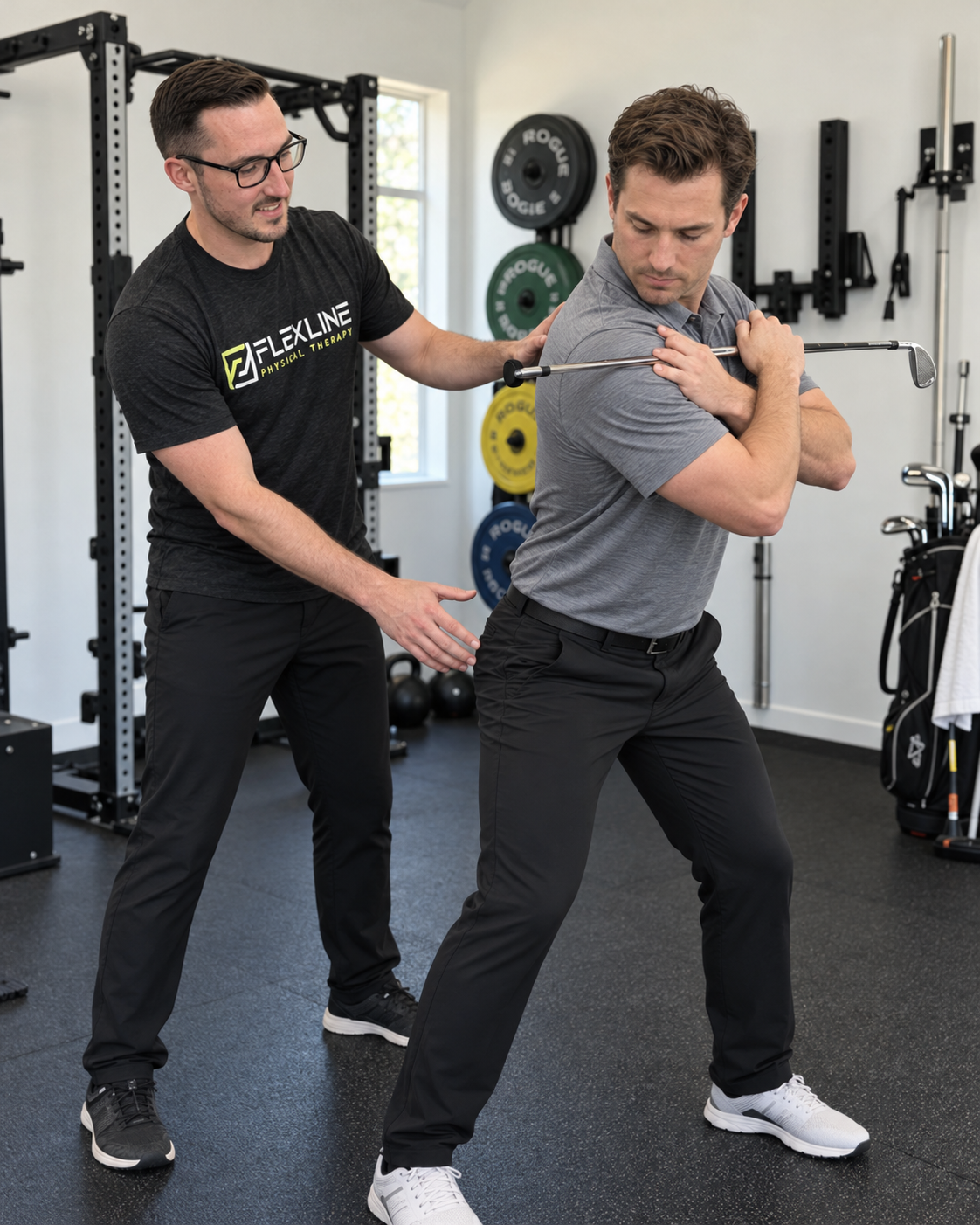
Golf shoulder pain often depends on which shoulder hurts and at what point in the swing. The lead shoulder (the front arm, the left shoulder for a right-handed golfer) tends to load differently than the trail shoulder (the back arm), and pain in one usually points to a different set of contributors than pain in the other.
Identifying which shoulder hurts and whether it happens in the backswing, at impact, or through the follow-through is the starting point for figuring out why.
WHAT MAY BE HAPPENING
The golf swing rotates the trunk and arms through a large range at speed, and the two shoulders are not doing the same job. The trail shoulder reaches a position close to its end-range of internal rotation and horizontal adduction at the top of the backswing, which can stress the rotator cuff and the front of the joint. The lead shoulder crosses the body and decelerates through impact and the follow-through, which can load the AC joint and the back of the shoulder. Limited rotation through the thoracic spine or hips often forces one or both shoulders to compensate with more motion than they are built to absorb repeatedly.
COMMON CONTRIBUTORS
Trail shoulder at the top of the backswing.
The combined position of internal rotation and horizontal adduction can irritate the rotator cuff or the front of the shoulder joint with repeated swings.
Lead shoulder through follow-through.
The cross-body deceleration at the end of the swing can stress the AC joint and the back of the shoulder, particularly with a longer or more aggressive finish position.
Limited thoracic spine or hip rotation.
When rotation is restricted elsewhere in the body, the shoulders often make up the difference, which increases load on both sides of the swing.
Practice volume and repetition.
A sudden increase in range sessions, lessons, or rounds without a matching increase in shoulder and trunk capacity is a common and modifiable factor.
Swing mechanics.
Certain swing faults can increase shoulder stress on one side more than the other, though mechanics are only one piece of a larger picture.
WHAT YOU CAN SAFELY TRY
Note which shoulder hurts and at what point in the swing (backswing, impact, or follow-through). This detail matters for an assessment.
Work on thoracic spine and hip rotation mobility, since limited rotation elsewhere often shows up as shoulder strain.
Reduce practice volume temporarily rather than continuing to swing through pain.
Warm up with rotational movement before playing or practicing rather than starting cold on the first tee.
Track whether pain is present with daily activities as well as golf, which helps separate a swing-specific issue from a broader shoulder problem.
Get the shoulder assessed if pain occurs on most swings, if it is present with everyday reaching or lifting and not just golf, if there is a noticeable loss of distance or control, or if a period of rest from golf has not led to improvement.
SIGNS THIS SHOULD BE ASSESSED
Imaging or a referral becomes more appropriate when pain persists despite a genuine reduction in swing volume and a period of targeted rehab, when there is a clear strength deficit that is not improving, or when a specific structural diagnosis such as a rotator cuff tear or AC joint injury has not yet been ruled in or out.
When imaging or referral may be appropriate
Frequently Asked Questions
-
No. Golfer's elbow refers to a tendon problem at the inside of the elbow. Golf-related shoulder pain is a separate issue involving the shoulder joint, rotator cuff, or AC joint, and the two are assessed and treated differently.
-
Both are common, but they tend to fail for different reasons. The trail shoulder is loaded most at the top of the backswing, while the lead shoulder is loaded most through impact and the follow-through. Which one hurts is a useful clue, not a full diagnosis on its own.
-
Not always. Many golfers can keep playing at reduced volume or with temporary swing modifications while the underlying issue is addressed, rather than stopping entirely. An assessment can clarify what is safe to continue.
-
Sometimes it helps, but swing mechanics are only one part of the picture. Rotation limits elsewhere in the body and shoulder strength and control matter as much or more, so addressing those is usually necessary alongside any swing changes.
Still unsure what is driving your shoulder pain?
Request a shoulder evaluation with
Flexline Physical Therapy in League City.
Related Reading
Shoulder Pain Treatment for Active Adults in League City, TX
Pickleball Shoulder Pain: Why It Happens and How to Keep Playing
This page is for general education and isn't a substitute for individual medical advice. Seek urgent care for sudden severe pain with deformity, numbness or weakness spreading down the arm, signs of infection, or chest pain and shortness of breath alongside shoulder pain.