
Shoulder Pain After Swimming: Why It Happens and What Helps
Written by Dr. Tim Berreth, DPT
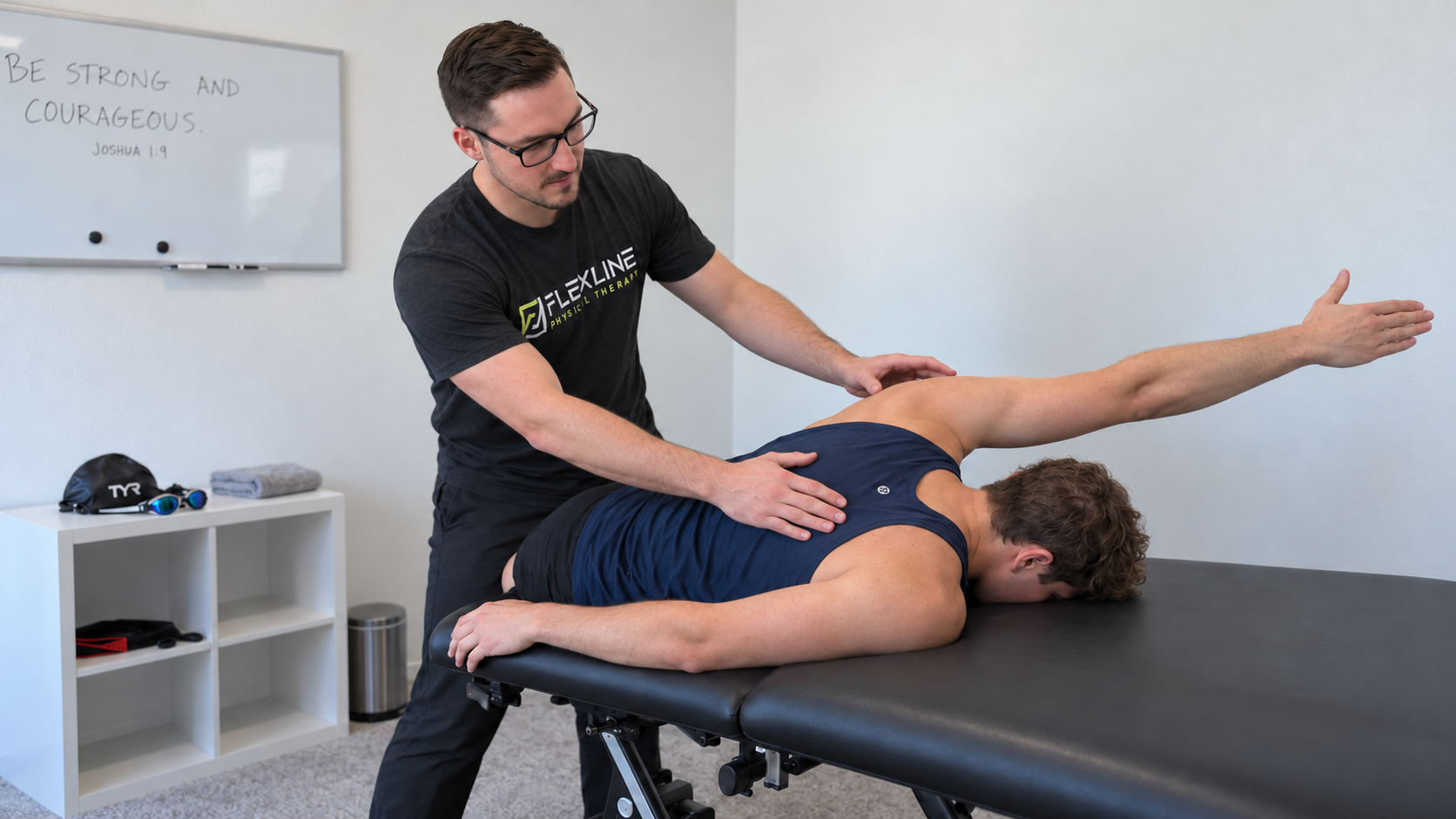
A shoulder that feels weak and a shoulder that feels unstable are related but not identical problems, and the distinction matters for figuring out what is going on. Weakness usually means a movement or a position is harder to control or produce force in than it should be. Instability usually means the shoulder feels like it is shifting, slipping, or about to come out of the socket, even if it never fully does. Some people have both at once. Identifying which one is actually happening, and when it shows up, is the starting point.
WHAT MAY BE HAPPENING
The shoulder is a shallow ball-and-socket joint that depends heavily on the rotator cuff, the surrounding muscles, and the labrum for stability, more so than most other joints rely on soft tissue rather than bone shape. When the muscles that control the joint are not strong or coordinated enough, or when the labrum or capsule has been stretched or injured, the humeral head can move more than it should within the socket. That extra motion can feel like weakness, like a vague ache, like a shoulder that "gives out" under certain positions, or like an actual sensation of slipping. The pattern of when it happens, overhead, at the side, under load, or during specific activities, gives useful information about which structures are likely involved.
COMMON CONTRIBUTORS
Rotator cuff weakness that has not kept pace with activity demands.
This is one of the more common and more modifiable contributors, particularly after a period of reduced training or a prior injury that was not fully rehabilitated.
Repetitive overhead loading without matching stability work.
Sports and lifting that emphasize range and power over control can leave a gap in the smaller stabilizing muscles.
A prior dislocation or subluxation.
Even a single significant event can stretch the capsule or damage the labrum enough to change how the joint feels afterward, sometimes for months or years if it was not addressed.
General joint laxity.
Some people have more naturally mobile joints throughout the body, which is not itself a problem but changes how much stability work is needed to keep the shoulder controlled under load.
Nerve-related weakness.
Less common, but a specific pattern of weakness, particularly if it is isolated to one muscle group or accompanied by numbness or tingling, can point toward a nerve issue rather than a purely mechanical one.
What you can safely try
Note exactly when the weakness or instability shows up: overhead, reaching behind the body, under a specific load, or during a specific sport movement. That detail changes what is likely happening.
Start or resume rotator cuff and scapular strength work at a level that does not provoke symptoms, building gradually rather than jumping back to prior training loads.
Avoid pushing through a position that produces a clear slipping or giving-out sensation until it has been assessed, since repeating that motion can reinforce the pattern.
Track whether the sensation is present with daily activities as well as sport or lifting, which helps separate a load-specific issue from a broader instability problem.
SIGNS THIS SHOULD BE ASSESSED
Get the shoulder assessed if there has been any actual dislocation or partial dislocation, if a specific movement reliably produces a slipping or giving-out sensation, if weakness is isolated to one specific muscle or movement rather than general fatigue, if numbness or tingling accompanies the weakness, or if the symptoms are limiting daily activities and not just sport or training.
When imaging or referral may be appropriate
Imaging or an orthopedic referral becomes more appropriate after any true dislocation, when there is a clear and isolated strength deficit that is not improving with targeted rehab, when instability symptoms continue despite a genuine period of stability-focused training, or when a nerve-related cause is suspected. A thorough examination often identifies the likely structures involved before imaging is needed, and imaging is most useful when it is answering a specific question raised by that examination.
FREQUENTLY ASKED QUESTIONS
-
No. A subjective sense of looseness or a shoulder that "moves too much" is not the same as a documented dislocation, though it can be an early sign of a stability problem worth assessing before a dislocation happens.
-
Often, yes. Many cases of instability, particularly those without a structural tear, respond to a progressive strength and control program. Whether surgery is appropriate depends on the specific structures involved, prior history, and how the shoulder responds to a genuine course of rehab.
-
Position-specific weakness usually points to a particular structure or range where control is lacking, rather than a global strength problem. That pattern is useful diagnostic information rather than something to work around indefinitely.
-
Yes. A prior dislocation, subluxation, or significant strain changes the tissue and the neuromuscular control around the joint, which is why incomplete rehabilitation after an initial injury is a common factor in recurring instability.
Still unsure what is driving your shoulder pain?
Request a shoulder evaluation with Flexline Physical Therapy in League City.
Related Reading
This page is for general education and isn't a substitute for individual medical advice. Seek urgent care for sudden severe pain with deformity, numbness or weakness spreading down the arm, signs of infection, or chest pain and shortness of breath alongside shoulder pain.