
Eccentric Overload Training: How the Beyond Power Voltra 1 Helps Us Rebuild Strength and Tendon Tolerance
Written by Dr. Tim Berreth, DPT
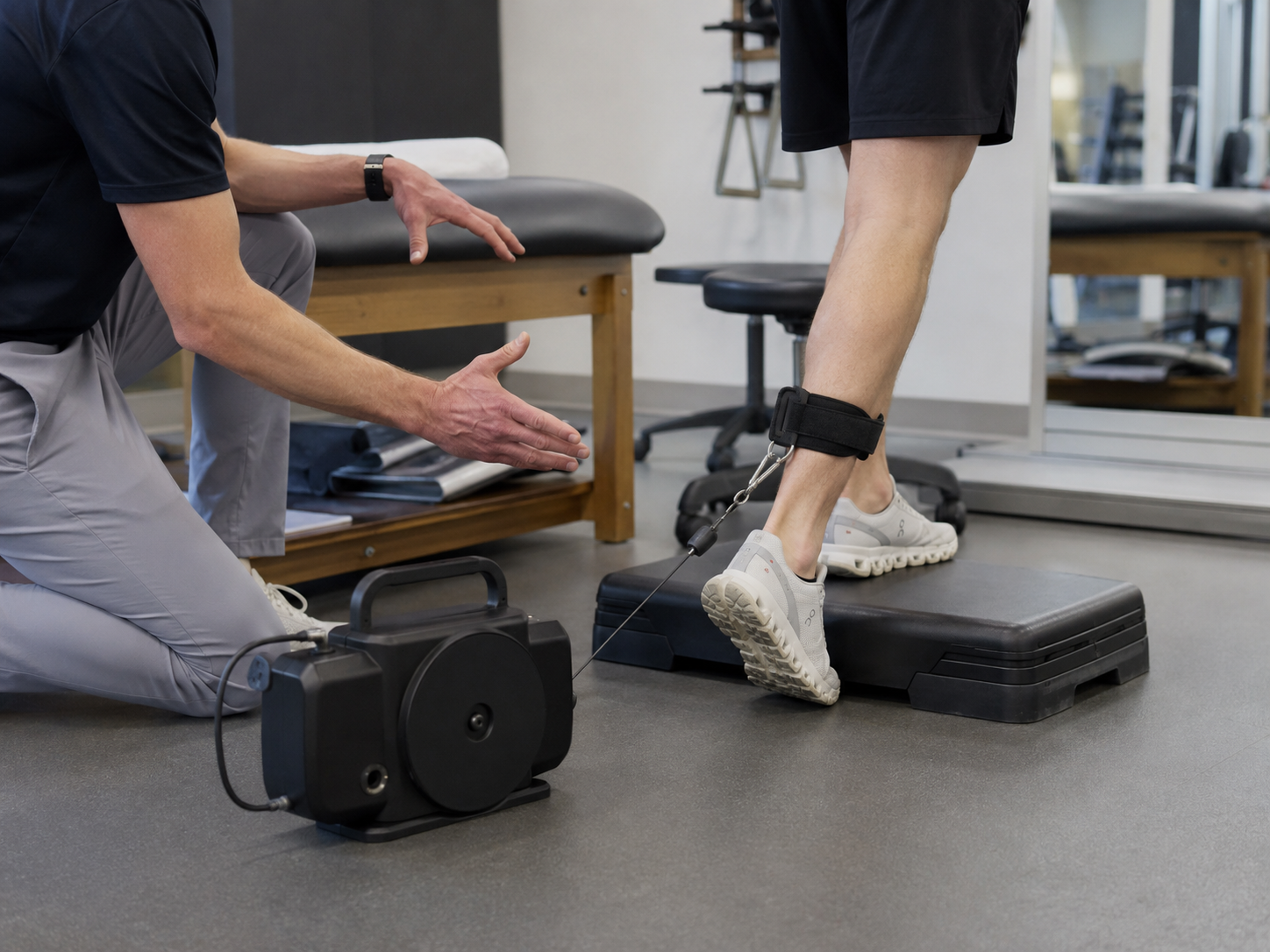
If you're rebuilding strength after an injury, or working through a stubborn tendon problem that never quite resolved, the load you use matters as much as the exercise itself. At Flexline, one of the tools we've leaned on most for this is the Beyond Power Voltra 1.
What the Voltra 1 Actually Does
The Voltra 1 is a resistance training device that covers a wide range of load and lets us control the eccentric phase of a movement specifically, the lowering or lengthening part of a rep, not just the lifting part. That range is what makes it useful across very different stages of care, from early strength work to late-stage tendon rehab, with the same piece of equipment.
Early Phase: Isometrics and Trackable Strength
What we look for: in the early phase after an injury, we're often not ready to load a joint or tendon through a full range of motion yet. We use the Voltra 1 for isometric work, holding a position under load, so we can start building strength safely.
How it helps: because the device tracks resistance and output, we can see strength numbers early and follow them over time, instead of relying on how a patient says they feel.
Tendon Rehab Phase: Eccentric Loading, Speed, and Power
What we look for: tendons respond differently than muscle does. Rebuilding tendon tolerance means gradually reintroducing load through the eccentric phase, then building back speed, rate of force development, and power as tolerance improves.
How it helps: the Voltra 1 lets us dial in eccentric resistance precisely and progress it in small, controlled steps, which is what tendon tissue needs to adapt without being aggravated again.
Training In Person or Remote
What we look for: not every patient can get into the clinic for every session. Some are in person the whole way through, some are hybrid, and some are fully remote.
How it helps: the Voltra 1 is portable enough that we can train patients on how to use it correctly wherever they are, then coach the same isometric and eccentric progressions over video for hybrid and remote patients as we would in the clinic.
Key takeaway: Strength and tendon rehab both come down to the right load at the right phase. The Voltra 1 gives us a way to control that precisely, whether a patient is in the clinic, at home, or somewhere in between.
Want to See How This Could Fit Your Recovery?
If you're working through a strength deficit or a tendon issue that hasn't fully resolved, this kind of targeted loading is worth a conversation.
