
Frozen Shoulder vs. Rotator Cuff Injury:
How to Tell Them Apart
Written by Dr. Tim Berreth, DPT
The clearest difference is what happens when someone else moves your arm for you. With frozen shoulder, passive movement is just as restricted as active movement, because the joint capsule itself is stiff.
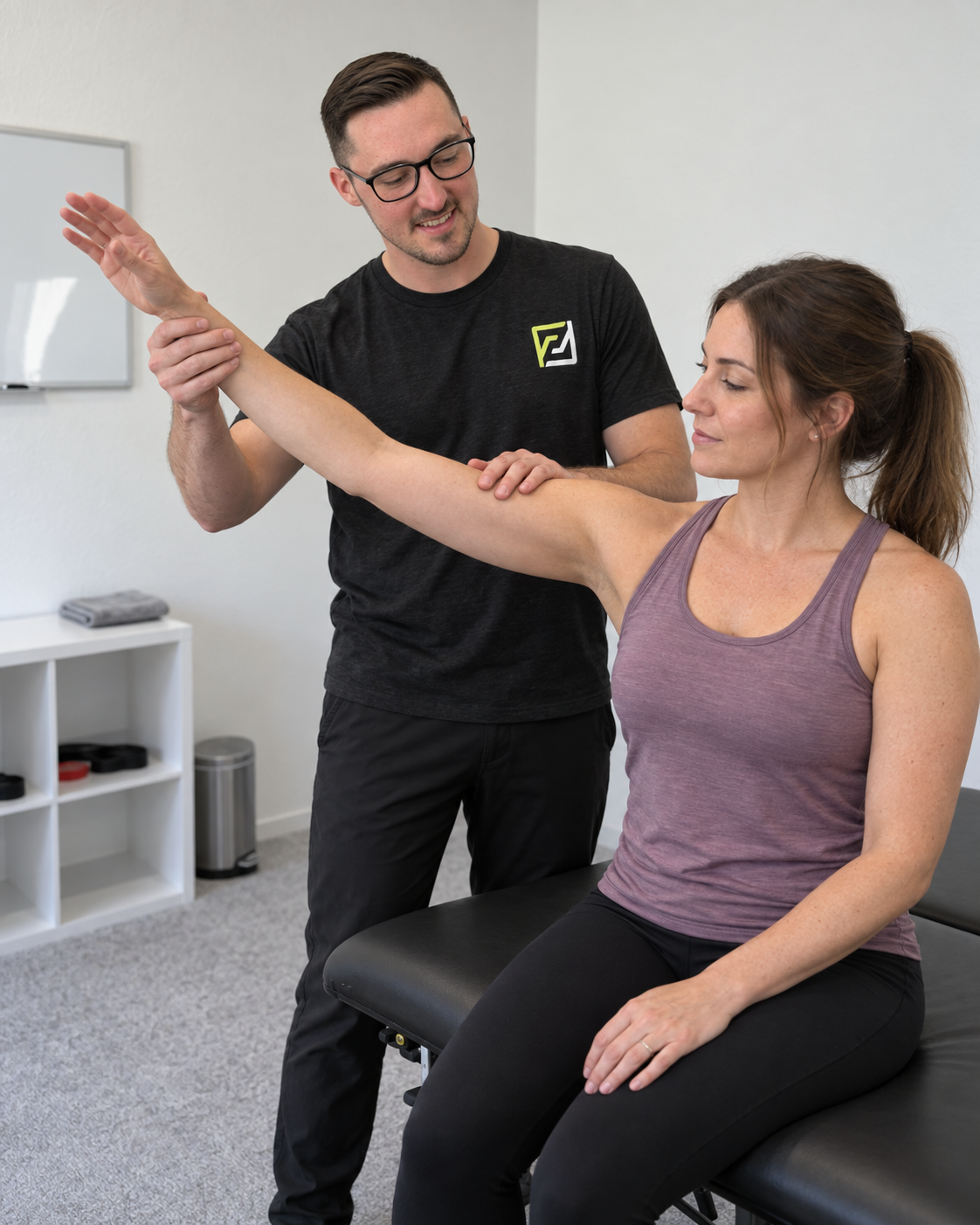
With a rotator cuff injury, someone else can usually move your arm through a much fuller range than you can move it yourself, since the limit is pain and weakness rather than a stiff joint. Both conditions can cause pain reaching overhead or behind your back, which is why they get confused with each other.
What may be happening
Frozen shoulder, also called adhesive capsulitis, is a stiffening and thickening of the capsule surrounding the shoulder joint. It typically develops gradually, often without a clear injury, and tends to move through recognizable phases: a painful "freezing" phase where motion tightens up, a "frozen" phase where stiffness dominates and pain eases somewhat, and a "thawing" phase where motion slowly returns. The full course commonly runs well over a year.
A rotator cuff injury covers a range of problems, from irritation and tendinopathy to a partial or full tear, in the muscles and tendons that stabilize and move the shoulder. Pain usually shows up with specific movements, especially overhead reaching or lifting, and there is often an identifiable trigger: a specific lift, a fall, a period of repetitive overhead work, or a gradual buildup tied to training load. Strength testing against resistance is often where a cuff problem shows up most clearly, since a torn or irritated tendon struggles to generate force even when the joint itself moves freely.
COMMON CONTRIBUTORS
Neither condition has one single cause, and having one risk factor does not confirm a diagnosis on its own.
FROZEN SHOULDER
more common between ages 40 and 60, more common in women, and more common in people with diabetes or thyroid conditions. It can also follow a period of shoulder immobilization, such as after surgery or a fracture elsewhere in the arm.
ROTATOR CUFF PROBLEMS
more common with repetitive overhead activity (lifting, throwing, swimming, certain jobs), with age-related tendon changes, and after a specific traumatic event like a fall onto an outstretched arm.
Both can occur in the same shoulder over time, and a stiff, guarded shoulder from an untreated cuff injury can sometimes contribute to secondary stiffness that mimics frozen shoulder, which is part of why a hands-on assessment matters more than symptoms alone.
WHAT YOU CAN SAFELY TRY
Keep the shoulder moving within a pain-tolerable range rather than avoiding it completely. Both conditions tend to respond better to guided, consistent movement than to strict rest.
For suspected frozen shoulder, gentle range-of-motion work (pendulum swings, wall walks within a comfortable range) can help maintain what motion is available while the underlying process runs its course.
For suspected rotator cuff irritation, reduce the specific aggravating movement (often overhead pressing or a wide grip) rather than stopping all upper body training, and add rotator cuff and shoulder blade strengthening on a consistent schedule.
Track whether stiffness or pain is the dominant limiting factor. That distinction is useful information to bring to an evaluation, since it points the assessment in a different direction.
Give any home modification a few weeks of consistent effort before deciding whether it is helping, since both conditions typically change slowly.
SIGNS THIS SHOULD BE ASSESSED
Get the shoulder evaluated if motion is limited in the same way whether you move it yourself or someone else moves it for you (a sign pointing toward frozen shoulder), if there is clear weakness with specific movements like lifting the arm to the side or rotating it outward (a sign pointing toward a cuff problem), if symptoms have lasted more than a few weeks without improvement, or if the shoulder is affecting sleep or daily reaching. A hands-on assessment of active versus passive range of motion, plus specific strength testing, is what actually separates these two conditions rather than guessing from symptoms alone.
When imaging or referral may be appropriate
Frozen shoulder is often diagnosed clinically without imaging, based on the pattern of motion loss. Imaging becomes more useful for a suspected rotator cuff tear, particularly when there is significant weakness, a clear traumatic mechanism, or symptoms that are not responding to a structured loading and mobility plan.
FREQUENTLY ASKED QUESTIONS
-
They can overlap, and a shoulder that has been guarded or underused because of cuff pain can develop secondary stiffness. An assessment that separately checks active motion, passive motion, and strength is the most reliable way to sort out what is contributing to the current picture.
-
It often does resolve over time, but the full course can run well over a year, and untreated stiffness during that time can affect daily function and sleep. Guided movement and a structured plan tend to support a smoother recovery than waiting it out alone.
-
No. Many rotator cuff tears and cases of tendinopathy respond well to a progressive loading program, and surgery is typically considered when conservative treatment has not improved function or when the tear pattern and symptoms point that way.
-
The most useful self-check is comparing how far your arm moves when you move it yourself versus when someone else moves it for you. A meaningful gap between the two points toward a cuff or pain-driven limitation rather than true joint stiffness, though a full assessment is what confirms it.
Still unsure what is driving your shoulder pain?
Request a shoulder evaluation with Flexline Physical Therapy in League City.
Related Reading
This page is for general education and isn't a substitute for individual medical advice. Seek urgent care for sudden severe pain with deformity, numbness or weakness spreading down the arm, signs of infection, or chest pain and shortness of breath alongside shoulder pain.