
Bench Press Shoulder Pain: Common Causes and Safer Modifications
Why the front of the shoulder hurts during bench press, what to modify first, and when it needs a closer look. League City, TX physical therapy.
Written by Dr. Tim Berreth, DPT
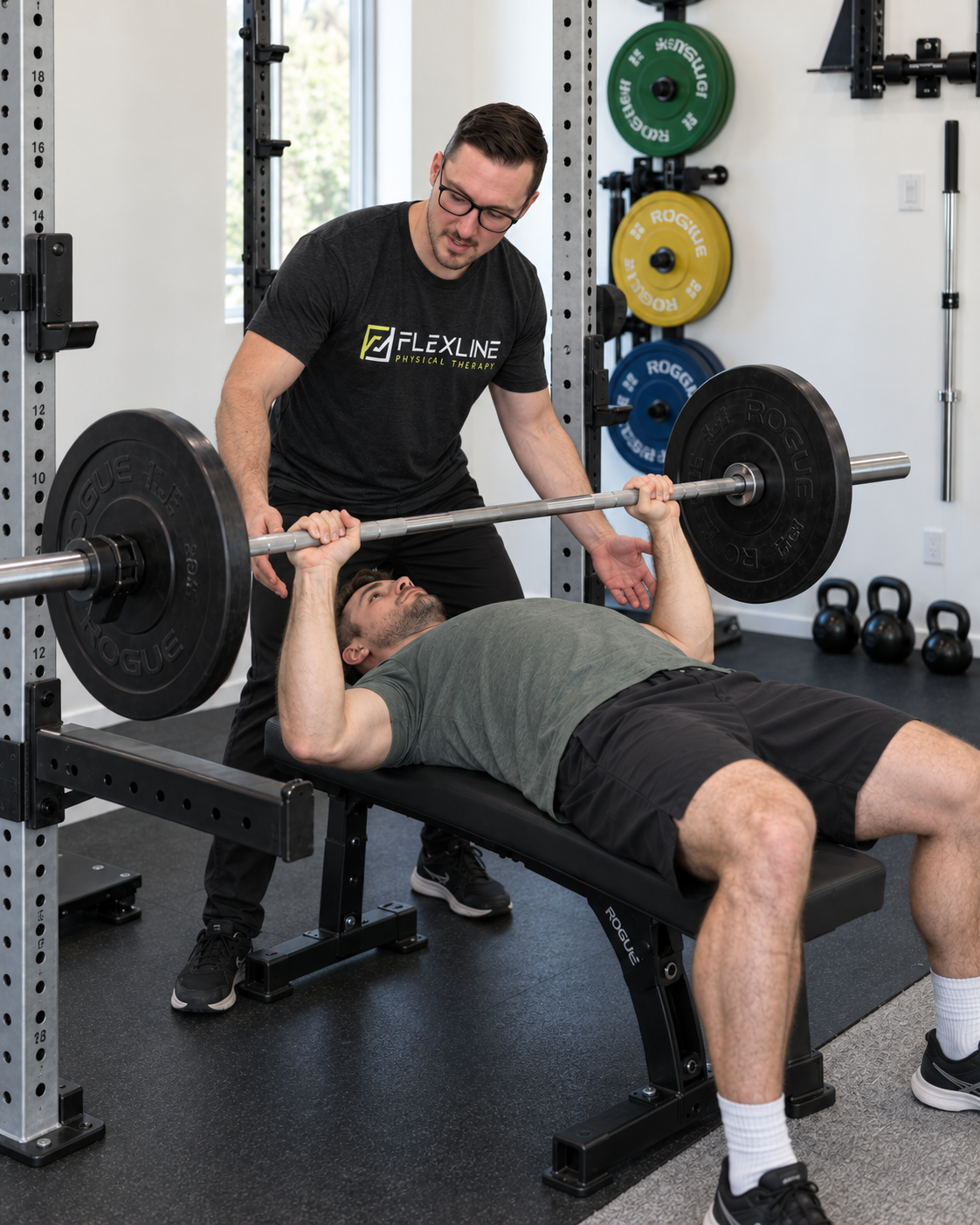
Shoulder pain during bench press usually shows up at the bottom of the rep, at the front of the shoulder, and it is most often related to how much load and range the front of the shoulder is being asked to control at once, not a single damaged structure.
For most lifters, adjusting bar path, grip width, or range of motion resolves it or makes it manageable while the underlying capacity is built back up. Pain that persists despite those changes, or that comes with weakness, is worth assessing directly.
Why the bottom of the bench press is the usual trigger
At the bottom of a bench press, the shoulder is in a position of flexion and rotation that puts the front of the joint capsule, the biceps tendon, and the front portion of the rotator cuff under the most tension of the whole lift.
If the shoulder does not have enough control or capacity at that end range, or if the bar path pushes the elbows too far back, that position becomes the aggravating point. This is a loading and positioning problem more often than a single-tissue problem.
Common contributors (not one cause)
Bar path and elbow position
Flaring the elbows too wide or letting them travel behind the shoulder line at the bottom increases stress on the front of the joint.
Grip width
A wider grip shortens the bar path but increases shoulder rotation and stretch. It may be too wide for an individual lifter’s mobility.
Load relative to capacity
A rapid jump in bench volume or intensity—or too much pressing without supportive strength work—can outpace current tolerance.
Mobility and control
Limited shoulder or thoracic mobility can make it harder to control the shoulder blades and distribute load through the press.
Existing irritation
Rotator cuff or tendon irritation that is manageable elsewhere can become symptomatic under heavy or high-volume benching.
What can you safely try
Reduce the range of motion temporarily by pressing to a point just above where pain starts, rather than stopping the lift altogether.
Bring the grip in slightly narrower and keep the elbows tucked closer to the body through the bottom of the rep.
Add a brief pause or slow the eccentric portion so the shoulder controls the descent instead of dropping into the bottom position.
Reduce load or volume for one to two weeks while keeping the movement pattern, rather than removing pressing entirely.
Add rotator cuff and upper back strengthening on non-bench days. A shoulder that only presses and never pulls tends to lose the balance that keeps this joint stable under load.
SIGNS THIS SHOULD BE ASSESSED
Pain persists after one to two weeks of changing range, grip, and load.
Symptoms also show up with reaching, sleeping, or normal daily activity.
There is noticeable weakness on one side or pain begins at a light weight.
The pain is sharp and localized rather than a general training ache.
When imaging or referral may be appropriate
Most bench-related shoulder pain does not need imaging. It becomes appropriate when there is a clear strength deficit that does not respond to a structured loading and modification plan, a suspected labral or rotator cuff tear based on assessment findings, or a specific injury (a missed rep, a sudden sharp pain during a lift) rather than a gradual onset.
FREQUENTLY ASKED QUESTIONS (FAQs)
-
Usually not right away. Reducing range, load, or volume while keeping the movement pattern is often more effective than stopping altogether, since some loaded, pain-free movement helps maintain shoulder tolerance while things settle.
-
It can, depending on individual shoulder mobility. A wider grip increases stretch and rotation at the bottom of the lift, which is more demanding for some shoulders than others. Narrowing the grip is one of the first modifications worth trying.
-
Not automatically. Dumbbells allow more individual control of range and path, which helps some lifters, but they also demand more shoulder stability through the full range, which can aggravate others. It depends on what is driving the pain.
-
A reasonable trial is one to two weeks of consistent modification. If pain is not trending down by then, or if it is affecting movement outside the gym, an assessment will identify what is actually driving it instead of guessing at more modifications.
Still unsure what is driving your shoulder pain?
Request a shoulder evaluation with Flexline Physical Therapy in League City.
Related Reading
This page is for general education and isn't a substitute for individual medical advice. Seek urgent care for sudden severe pain with deformity, numbness or weakness spreading down the arm, signs of infection, or chest pain and shortness of breath alongside shoulder pain.