

Why Your Shoulder Hurts When Reaching Overhead
Written by Dr. Tim Berreth, DPT
Shoulder pain that shows up specifically when you reach overhead, putting a dish away, reaching for a top shelf, or pressing weight above your head, usually means the space between your rotator cuff tendons and the bone above is narrowing under load.
This pattern is often called impingement, though that term describes a pattern of pain, not one single cause. What actually helps depends on what's limiting that space: tissue irritation, a mobility restriction, or how your shoulder blade moves during the reach.
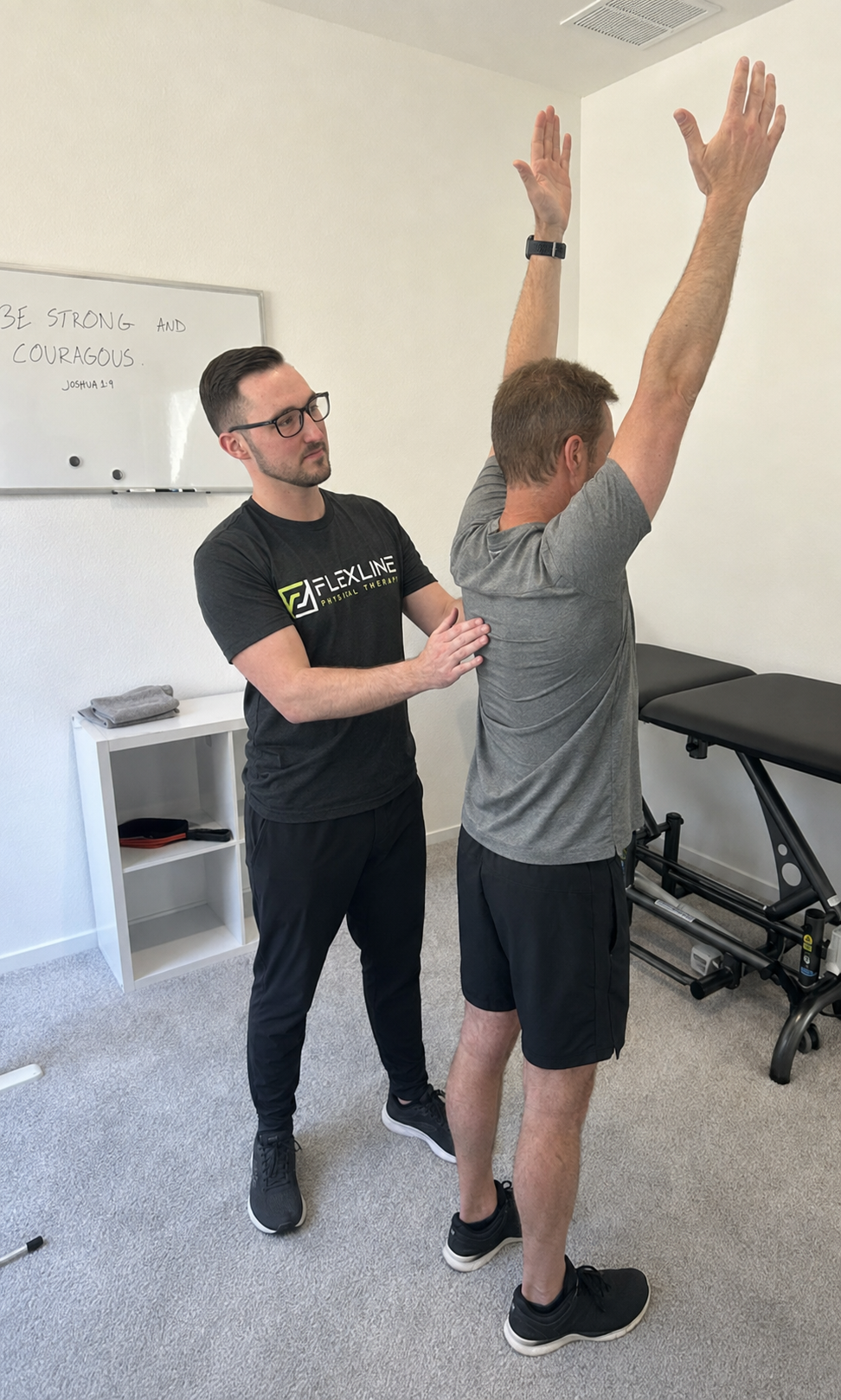
Why overhead motion is different
Raising your arm overhead requires your shoulder blade to rotate and your rotator cuff to keep the ball of the joint centered while the space above it narrows naturally at certain points in the motion. If any part of that sequence is off, reduced mobility, weak or fatigued rotator cuff muscles, poor scapular timing, that space gets crowded more than it should, and the tissue in it gets irritated.
Common Contributors

Rotator cuff tendinopathy or irritation from training load
Reduced thoracic spine or shoulder mobility that forces more motion through an already narrow space
Scapular control issues, the shoulder blade not rotating enough during the reach
Postural loading from long stretches at a desk that shows up during activity
A sudden increase in overhead training volume
What you can safely try

Modify range or load on overhead movements rather than avoiding overhead motion entirely
Add scapular control work before adding more overhead load
Work on thoracic spine mobility if a stiff mid back is limiting arm elevation
Avoid pushing through sharp pain in a specific arc of motion. That's a sign to regress the movement, not power through it
Signs this should be assessed
If overhead pain has lasted more than two to three weeks, is limiting specific lifts or daily tasks, or comes with noticeable weakness, get it evaluated.
A movement assessment identifies which of the above is actually driving it. Treating a mobility problem like a strength problem, or the reverse, tends to stall progress.
When imaging or a referral may be appropriate
Imaging usually isn't the first step for overhead shoulder pain without a specific traumatic injury.
Reference: https://doi.org/10.2519/jospt.2025.13182
It becomes more relevant after a specific injury, when strength testing shows a significant deficit, or when a structured plan hasn't produced expected progress after several weeks.

Frequently Asked Questions
-
"Impingement" describes a pattern, not a single diagnosis. Rotator cuff irritation, mobility limits, and scapular control issues can all produce the same overhead pain.
-
Usually not. Modifying the range, load, or tempo on the movement that hurts, while addressing the underlying limitation, is typically more effective than stopping.
-
It can help if mobility is the limiting factor. If the issue is strength or control instead, stretching alone won't resolve it and can sometimes aggravate it further.
-
Two to three weeks without improvement, or any real limitation to training or daily tasks, is a reasonable point to get assessed.